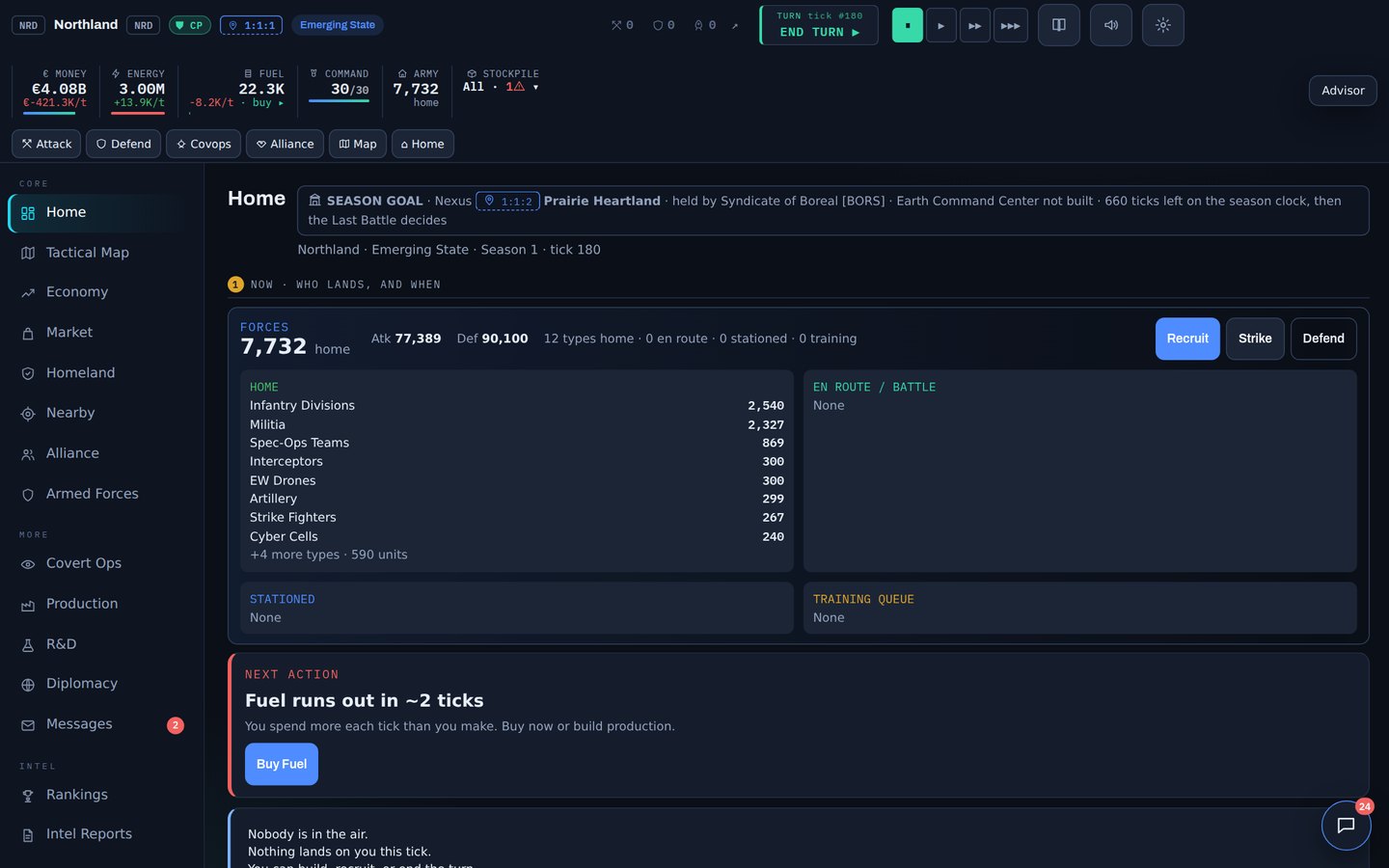
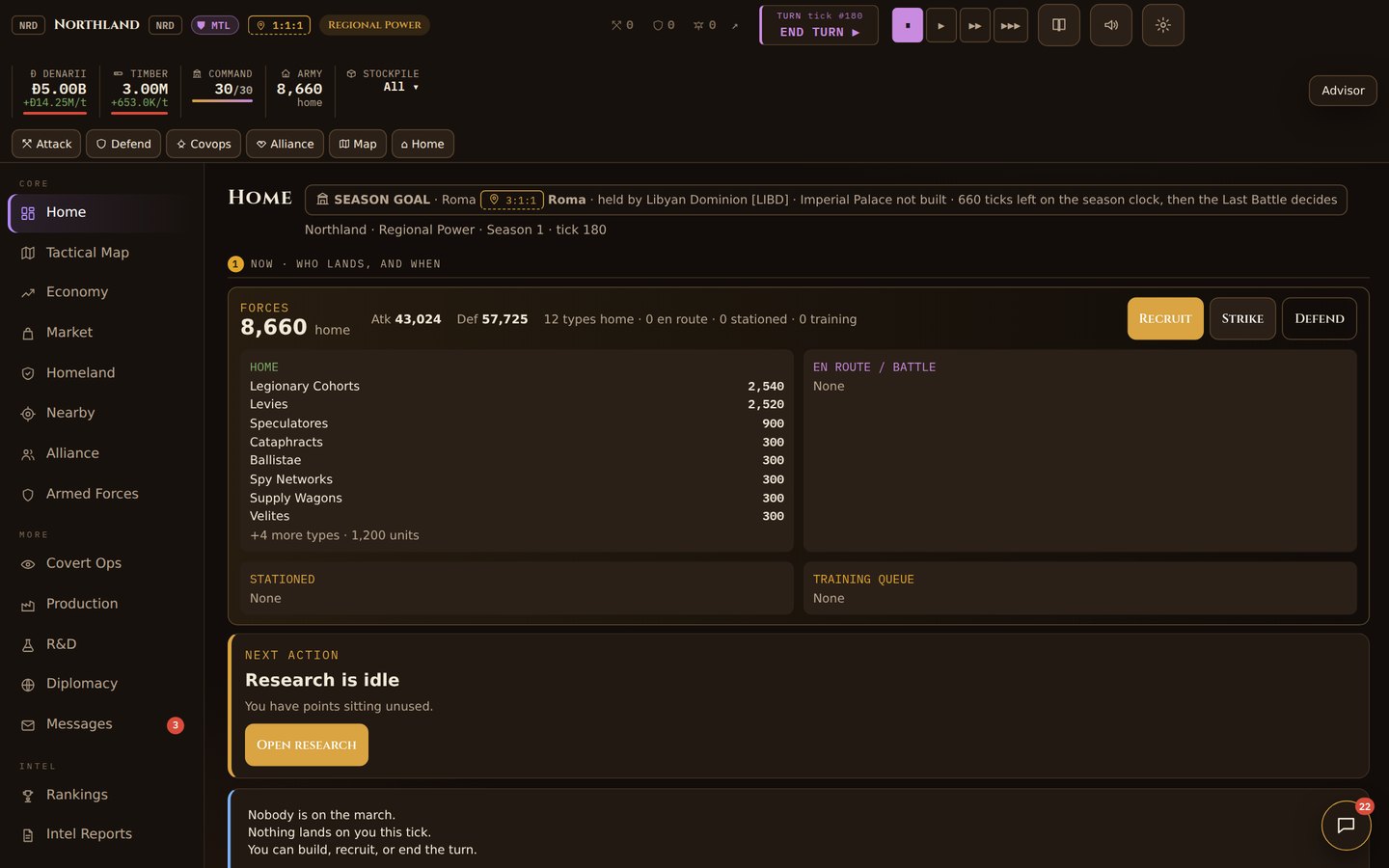
The computer nations used to fight one battle at a time, and quietly got a few things for free. Now every rival alliance has a war council that plays the whole season to win, and it pays exactly what you pay. In the live world, a stand-in can run your nation while you sleep. Update 3 is in Terrastate and Romaterra, and your saved game keeps working.
Every computer-led alliance now has a war council. It reads the season: grow in the opening, pick one rival to take ground from, and turn everything toward the Nexus (in Romaterra, Roma) when the end comes near. It explains its plan to its members in the alliance chat.
Alliances sign non-aggression pacts to keep their flanks quiet, form coalitions against a runaway leader, end a pact honourably before they attack, and sue for peace when a war is lost. A sly leader may still break a pact for a surprise strike. Nobody keeps more than four pacts, so the map never freezes.
An alliance scouts its target, shares the report, raises a war alert and launches a joint strike that its members join. When one of them holds the Nexus, the others send troops to defend it.
No free command points, no free influence, no bigger economy. It pays the same costs as you and only knows the defence of your land after it has scouted it, just like you. Warlord difficulty now means sharper play, not more money.
Offline for six hours, or set to Away? A stand-in commander runs your nation with your own resources: it builds, researches, fixes shortages, defends and helps your allies. On Full it also joins your alliance's strikes. You choose Guard, Full or Off in Homeland.
The moment you return, the stand-in hands back command and Home shows what it did. Your alliance sees a robot icon next to your name while it plays for you. After five days it stands down.
Pick a pattern, three colours and a symbol. Tap your flag in the top bar, or open Settings. In Romaterra it is your standard.
Your flag shows in the rankings, your alliance, the Nexus panel and on every nation you look at. Every computer nation has its own. It is only looks: no bonus, no change to the balance.
When a member of a computer alliance is attacked, it calls for help at once and up to three allies who can arrive in time send part of their army. The Legion reserve deploys on its own.
Alliances declare war more often, but they scout first and defend twice as hard as before. In our tests fewer regions changed hands than in Update 2.
Computer nations no longer attack an alliance their own alliance has a pact with by mistake. Breaking a pact is now a decision, made by a leader with that kind of character.
The hardest difficulty in solo used to give the computer 15% more economy. Now it gets nothing extra. It just plays sharper and hunts you harder.
A season used to stop dead on its last tick, even with armies halfway through a battle for the prize. Now the end is the best part: the whole world marches on the Nexus (in Romaterra, on Roma), and whoever holds it the longest wins the season. Update 2 is in Terrastate and Romaterra, and your saved game keeps working.
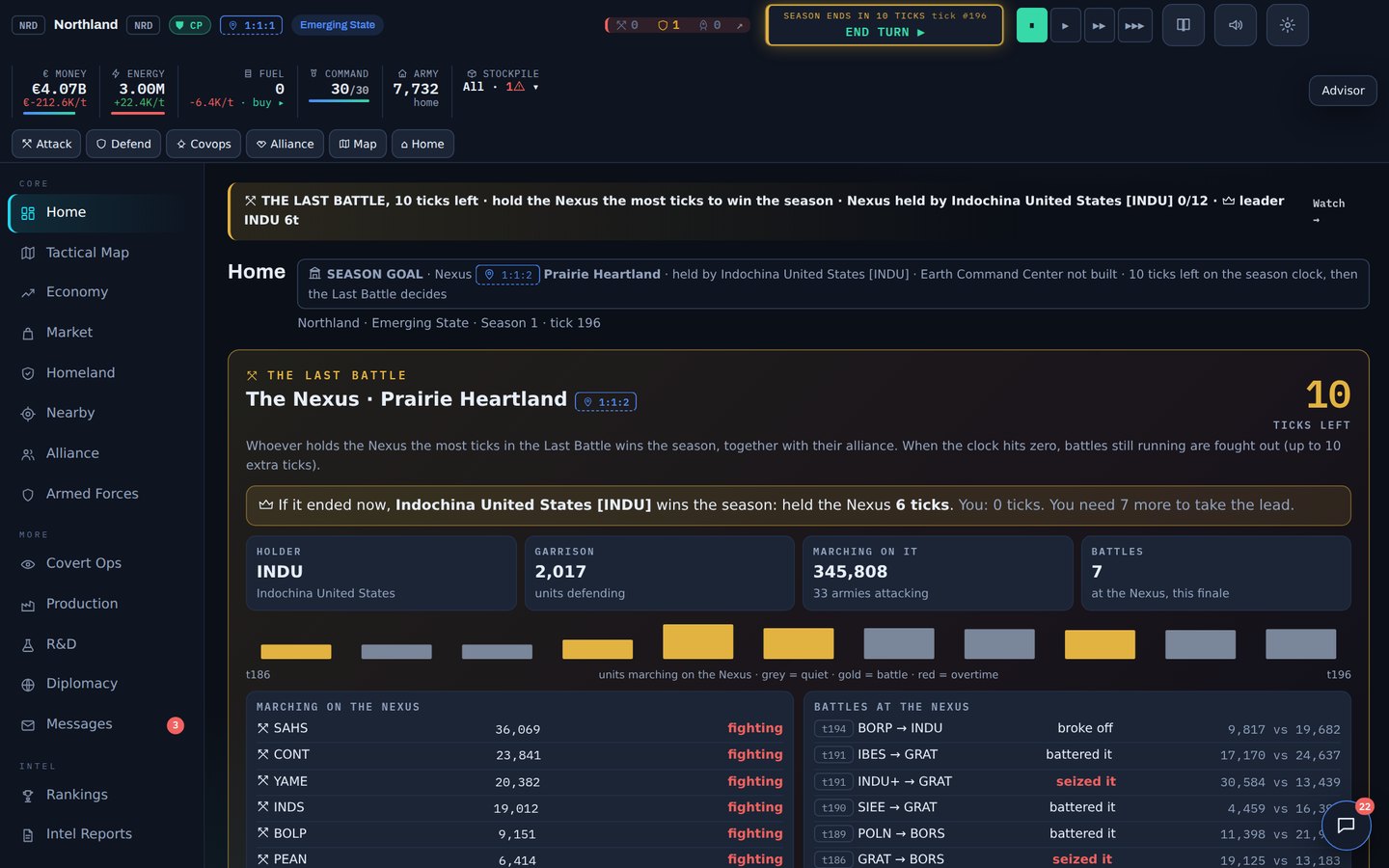
Near the end of a season a big gold panel opens on Home, Homeland and Rankings: who holds the prize, how many defend it, how many armies are marching on it, every battle with the numbers, and a clock that counts down.
From the moment the Last Battle starts, the game counts how many ticks each nation holds the prize. Most ticks wins the season, and the whole alliance shares the win. The top bar always shows who leads, and how many ticks you need to take the lead.
When the clock runs out while armies are still fighting for the prize, the season does not stop. Overtime runs until the last battle is over, with a limit. Only armies that left before the clock ran out take part.
In the last part of a season, the launch screen tells you straight away whether your army will make it in time to fight, or land too late.
The start of the Last Battle, the state of play, every change of leader in the hold race and the final result all appear in the world news.
The season ends with the report of the Last Battle: who won, the final hold race, how many battles there were, and what your part was. The winner goes into the Hall of Fame.
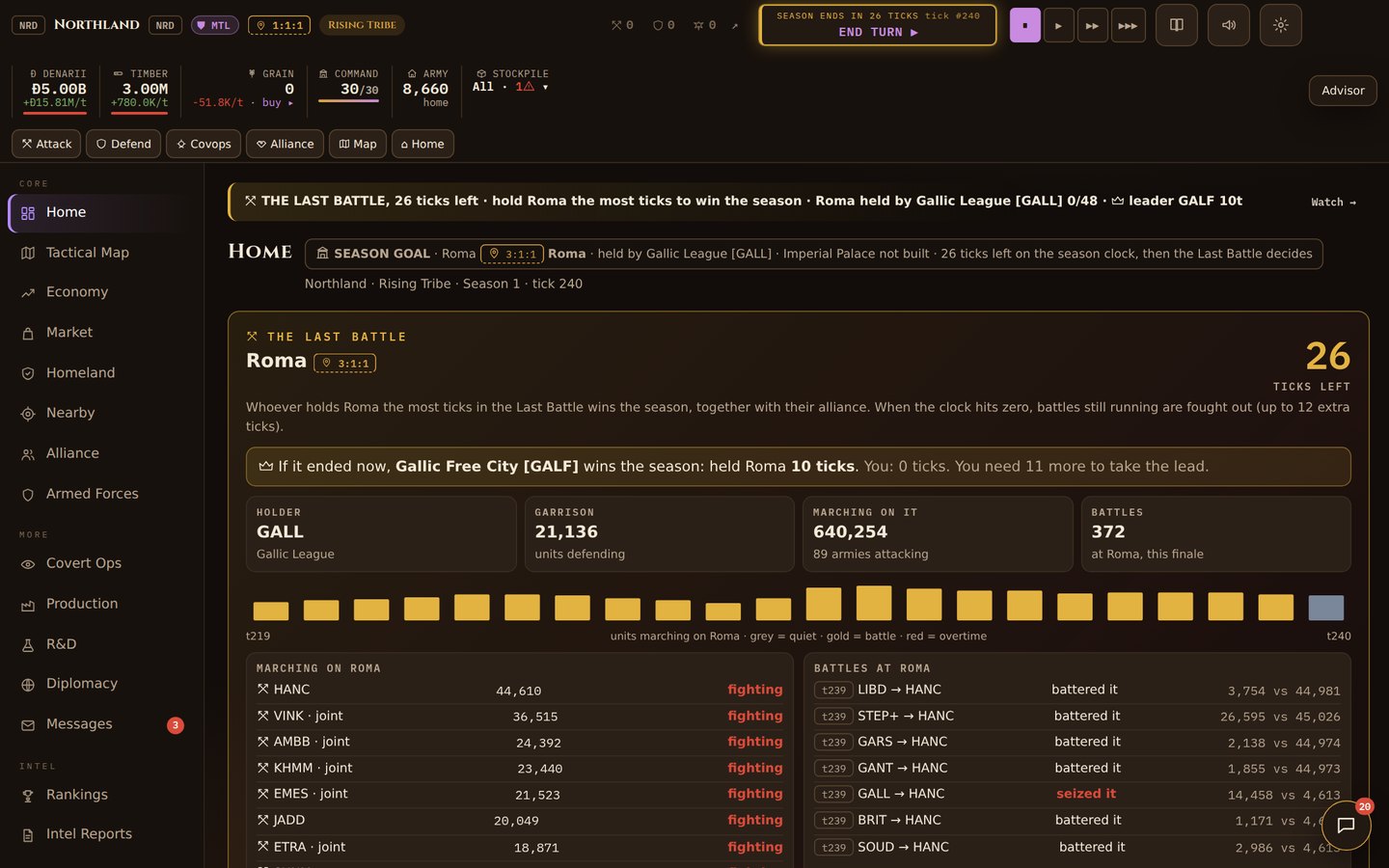
On Home, every army on the move now shows where it is heading, when it lands, and in a joint attack, who it marches with.
A Withdraw button on Home takes your army out of a joint attack, and your alliance gets a message. The leader of a joint attack can call it off for everyone.
Strike fighters and bombers were too weak for their price. They now hit harder and cost less, so they are worth building. Air defence still counters them.
After your first turns, Home teaches you to grow in three steps: scout a neighbour, take your first region, hold three regions.
The help, the season rules and the start screen now all explain how a season is won, including the Last Battle.
Romaterra plays four times faster than Terrastate, so its Last Battle is longer in turns: it runs for the final 80 turns of a full season, and in shorter single-player seasons it scales with the length you picked. The live world, when it opens, is timed so a season ends at 9 PM in New York (6 PM in Los Angeles).

Version 1.0 is for Terrastate and Romaterra alike. The rules of a season did not change. What changed is how the game talks to you: what is happening, what to do next, and why. Your saved game keeps working. Open the game in the same browser and carry on.
Who is in the air, and when do they land? Incoming attacks are red, help from allies is green, your own strikes are blue. Your army sits right underneath, with Recruit, Strike and Defend.
The homeland you pick is the homeland you get, with its economy. No AI nation can slip into your spot while the world is set up.
A compact top bar with your supplies in one row, four clear buttons on your first evening, wide lists you can swipe sideways, and a map that follows your finger.
Line held, region taken, attack failed: you read it at a glance, with your losses and theirs, and the next move right under it.
The defensive line uses militia and infantry you already have, never units you have not unlocked yet. Soldiers still in training count toward your defence.
The small overview map now sits top left, so it is always in view, also on smaller laptop screens.

Another nation's strength stays unknown until a scan lands. A scan costs influence and a command point, and their radar can bounce it. No scan, no forecast.
Break the garrison and the region is yours, with a cut of what they had stored: five percent, with a cap. A shield or beginner protection still stops both the flag and the loot.
You choose your path after you have seen one battle. That choice locks for the whole season, so now you know what you are choosing.
The price you read is the price you pay. Buying into a hot market, or buying in bulk, costs more tax. Covering a real shortage costs less. Your buys and sells show as dots on the chart.
The strongest late units (Swarm Drones, Ghost Squadrons and Titan Mechs in Terrastate) no longer decide a season on their own. They hit less hard and cost more.
Combat and stockpiles refuse broken numbers, so one bad tick can never freeze your game.
In your first ticks a neighbour tests your shield. They cannot take the ground while beginner protection holds, so you get to watch a real attack without losing anything.
The nations around you have a name and a temperament: some raid, some hold, some are rich and thin. They remember a strike.
Production shows what a place is (a breadbasket, a works, a fortress) and how full it is. A technology says what it unlocks before it mentions a percentage.
Captures, held lines, incoming fire and successful covert work are written into the alliance feed automatically.
Wars grow in stages, from scouting to occupation. Alliances vote on world laws. Landmarks give a region a special reward worth fighting for.
Every tip card has a close button, and stays closed in your browser until you reset your tips in the settings.
Everything above is also in Romaterra, in Roman dress: legions instead of tanks, denarii instead of euros, and Roma with its Imperial Palace as the prize. In Romaterra the late units that were toned down are the Slinger Swarms, Shadow Exploratores and War Elephants.

Prefer a printable version? Terrastate note (PDF) · Romaterra note (PDF)
We played full seasons of 1.0 and clicked every button on laptop and phone. Nothing broke, but a few screens said too much, or said it twice. This patch cleans that up. It is in Terrastate and Romaterra, and your saved game keeps working.
In the Alliance room, one Scan button now reveals every unknown fleet heading for a teammate, not just the first one. What you found is shown right there: who is coming, how many, and with what.
In Homeland, a revealed fleet now shows what it carries. With several unknown fleets on one region, Reveal all scans them in one go.
Under attack, Home and Homeland showed the same warning up to six times, sometimes with different numbers. Now each screen says it once, with the total strength of everything that is coming.
Your own alliance no longer shows up in your list of targets, or in the covert ops list. Field Recon now starts with your neighbours instead of a country on the other side of the world.
When their radar stops your scout, you now read that it bounced. Before, you got a report full of strange symbols.
The red SOS warning is two short lines with its buttons, instead of filling the whole screen. The covert ops lists fit on the screen.
Your alliance advisor now sees an attack the moment it is launched, instead of saying all is quiet for a few more turns.
Allies who came to defend you now have a Send home button on Home. And once nothing has come at that region for 24 turns, they head home by themselves.
Army readiness now says how hard you fight, for example "Ready fights at 85% strength". In Romaterra, armies are "on the march" instead of "in the air".